

Read the video transcript
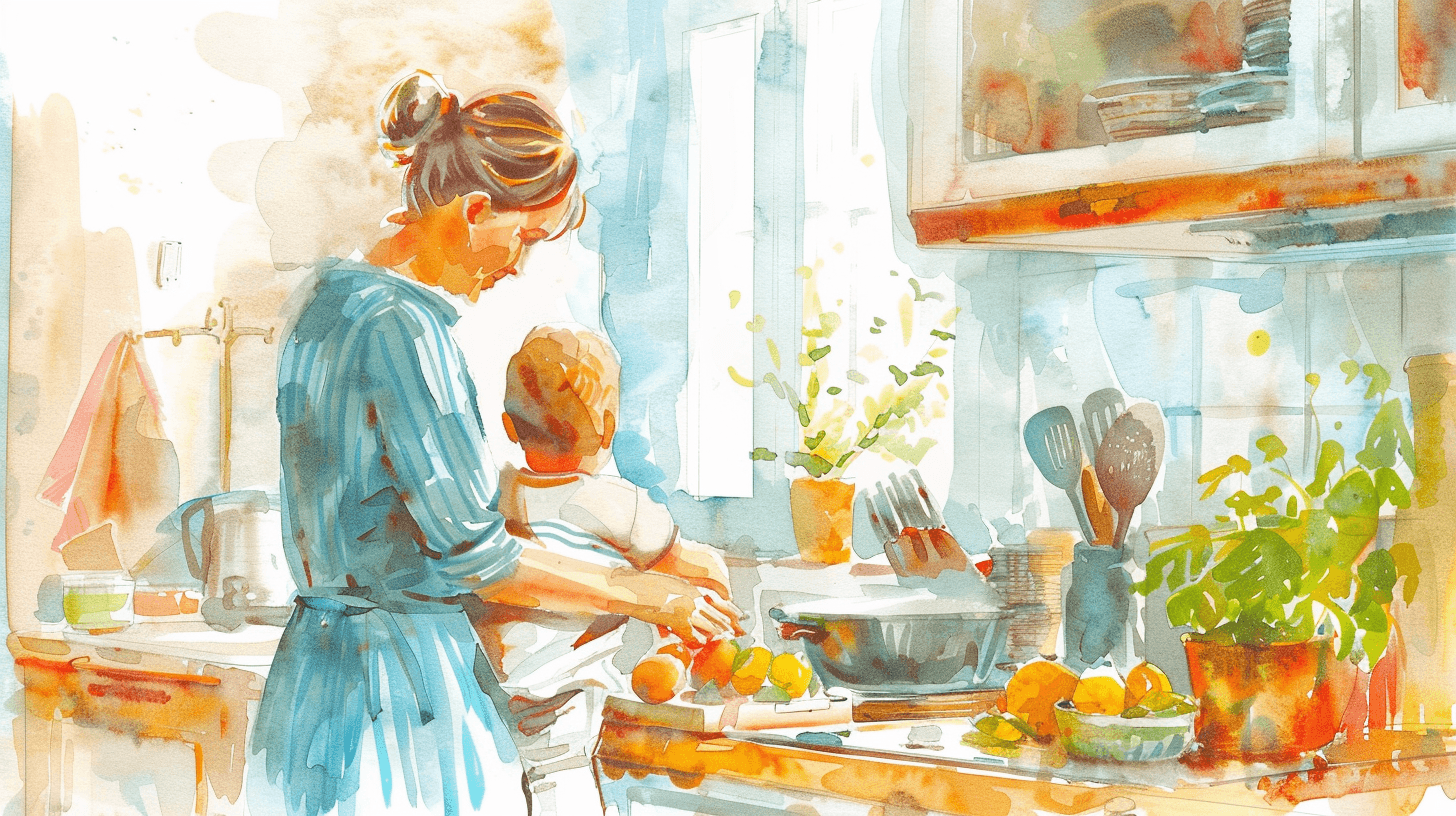
A mom was talking to me this week about how irritated she was postpartum because she couldn't finish a meal while she had to watch her partner just kind of eat away. So I was talking to her about how it's not really about the food. It's about the loss of normalcy and identity and autonomy that happens postpartum when your needs get constantly interrupted, that you're not even able to finish a meal because baby starts crying or you need to go tend to baby. And what I was telling her is that that irritation is information. It's your brain telling you that you need more support during this time and that obviously you deserve to eat. So go get a snack because you deserve it.
Your dinner is getting cold while your partner keeps eating. You get up for the baby again, and even the sound of their fork starts to grate.
A mom described that frustration to me, and I talk about it in the video above. The meal matters. So does the repeated interruption of your needs while someone else's time stays their own.
Why does everything my partner does irritate me since the baby?
That mom could never finish a meal while her partner ate uninterrupted. The food was only the surface. What she was reacting to was the loss of normalcy, identity and autonomy that happens postpartum, when your own needs get interrupted over and over.
Irritation is often just the top layer. Underneath it there can be sadness and grief: for your old independence, your old pace, your old sense of self, your old freedom. Your partner can still sit down and eat a hot meal. You can't. That gap is a small, daily reminder of how much has changed for you.
A lot of moms take the irritation as proof that something is wrong with the relationship. Sometimes there are real problems to work on. Often, though, the irritation is information. It's your brain telling you that you need more support during this time.
You can love your partner and still be irritated by the way they chew. If the grief is the part that hits hardest, grieving who you were before the baby goes deeper.
How much of this is the sleep deprivation?
Broken sleep can shorten your patience and leave less room for the small annoyances. In a 2022 Canadian survey, moms who rated their sleep as poor were more likely to report intense anger (Ou and colleagues, University of Victoria and University of British Columbia). That is a link, rather than proof of cause.
It is worth planning some protected sleep and noticing what changes. Irritability that persists also deserves attention, even when sleep loss is part of the picture.
Why does my partner get the worst of it?
By evening, a lot of moms have been held onto, nursed on, climbed on, cried at and needed for twelve hours straight. That's a lot of sensory input, and your brain has been on alert the whole time, listening for the baby and tracking the next feed, the next nap, the next thing. Then your partner walks in, puts a hand on your back, and asks how your day was.
That touch or that question can land as one more demand on a system that's already full. The snap that follows is about capacity: you've run out of room for one more input, even a kind one. This is a big part of being touched out. Feeling touched out goes into the sensory side in more detail, including what your partner needs to understand.
Your partner is also often the closest person when you hit your limit, and the one you feel safest with. That can be part of why the frustration comes out at home.
Then there's the load. If you're the one tracking feeds, naps, appointments and what size diapers come next, every "Where are the wipes?" is another interruption and another reminder that the tracking is yours. Each one is small. Dozens a day keep you on call even when your partner is home. That's the mental load. How to explain the mental load to your partner has words for that conversation, and this post for partners is one you can send to yours.
Can postpartum hormones make you irritable?
They can be part of it. Estrogen and progesterone climb during pregnancy and drop quickly after birth. Researchers at the University of North Carolina at Chapel Hill reviewed the evidence and concluded that a subgroup of women seem to be particularly sensitive to these changes when it comes to mood (Schiller and colleagues, CNS Spectrums, 2015).
Mood changes in the first two weeks after birth are often the "baby blues," which the National Institute of Mental Health describes as mild and short-lasting. NIMH also says mood changes that are severe or last longer than two weeks after birth may signal postpartum depression (2023).
Hormones rarely act alone, though. They land on top of the sleep loss, the touch, the load and the grief, which is why it helps to work on several at once.
What actually helps when everything grates?
Start by treating the irritation as information. When it flares, ask yourself: what do I need right now? The answer is often more basic than you'd expect.
Eat the meal. That mom in the video deserved to eat, and so do you. You have the right to finish a meal. Ask your partner to take the baby while you sit down and finish your meal. You can trade off so you both get a turn.
Protect one stretch of sleep. If you can, set up one longer block a few nights a week where your partner handles the baby and you sleep somewhere you can't hear the baby. Earplugs and a closed door help. If you're nursing, your partner can still do everything except the feed itself: bringing the baby to you, the diaper, the burping, the resettling. If you're considering a bottle for one feed, ask your lactation consultant or pediatrician how that fits your plan.
Take a few minutes with no input. Ten minutes with nobody touching you or asking you anything: a shower, a walk around the block, headphones in the car. Tell your partner ahead of time that this is how you recharge, so it doesn't read as rejection.
Say the need before it turns into a snap. "I'm at my limit. Can you take the baby so I can eat?" tends to get further than a sigh at the sound of their fork. Save the bigger conversations for a calmer moment.
Ask for whole jobs. A handoff that comes with a question attached still keeps you on call. Ask your partner to own one routine from start to finish, like bath and bedtime, and to work out the details without checking with you, so it's off your mind as well as your hands.
Repair when you snap. You'll still snap sometimes. A quick "That came out harsher than I meant. I'm running on empty and I need help" can keep one bad moment from turning into a bad night.
When is irritability a sign of postpartum depression or anxiety?
Irritability, frustration and restlessness are listed symptoms of perinatal depression (NIMH, 2023). Postpartum Support International lists anger, irritability and rage among the symptoms of both perinatal depression and perinatal anxiety. So irritability can be part of a treatable condition, even if you don't feel sad.
In that Canadian survey, about half of the moms who reported intense anger also scored in the range for probable depression, and about half didn't. Anger can show up with depression or on its own, and either way it deserves attention.
It's time to talk to a professional if:
- It's there most of the day, most days, for more than two weeks.
- It's aimed at almost everyone, including your baby, older kids and friends.
- You've had real sleep or real help, and it hasn't eased.
- It comes with feeling flat, hopeless or guilty, or with constant worry and trouble relaxing.
- The anger feels out of control or frightens you.
One pattern needs a call to your OB, midwife or doctor today: you're sleeping very little but don't feel tired, and you have much more energy than usual, racing thoughts, or you're doing things that aren't like you. That's different from lying awake exhausted and worried. When you call, mention any personal or family history of bipolar disorder. If it comes with confusion, strange beliefs, or seeing or hearing things others don't, call 911 or go to the nearest emergency room.
If you're thinking about suicide or need crisis support, call or text 988. Call 911 if you or your baby is in immediate danger. For support that isn't an emergency, Postpartum Support International's HelpLine is 1-800-944-4773 (call or text).
You can start with your OB, midwife or primary care doctor, or go straight to a therapist who works with postpartum moms. If the anger itself is what scares you, managing postpartum rage covers what's happening and how it's treated. You don't need to know which of these it is before you ask for help. Sorting that out is part of what an evaluation is for.
If you'd like to talk it through with me, you can book a free 15-minute consultation. I see moms in person in Austin, TX, and online across Texas and 40+ PSYPACT states, and that first call is a chance to figure out what kind of support fits.
When everything grates, start with what you need. And go eat something, because you deserve to.
Sources
- Ou CH, Hall WA, Rodney P, Stremler R. Correlates of Canadian mothers' anger during the postpartum period: a cross-sectional survey. BMC Pregnancy and Childbirth, 2022.
- Schiller CE, Meltzer-Brody S, Rubinow DR. The role of reproductive hormones in postpartum depression. CNS Spectrums, 2015.
- National Institute of Mental Health. Perinatal Depression. 2023.
- 988 Suicide & Crisis Lifeline. What to Expect.
- Postpartum Support International. Perinatal Mental Health: Signs, Symptoms and Treatment and Get Help.
Specialized Postpartum Support
Get compassionate, evidence-based care tailored to your postpartum journey.
Start Your Therapy Journey
Work with Dr. Jana Rundle, a licensed psychologist specializing in maternal mental health.
Schedule Free ConsultationFrequently asked questions
- Is it normal to be irritated with your husband after having a baby?
- Many moms feel more irritable after a baby, particularly with broken sleep, interrupted needs and an uneven load. That context matters. Persistent or frightening anger also deserves professional attention, even when the practical strain is real.
- Why does everything my husband does annoy me after the baby?
- Small sounds or questions can land harder when you've had little rest and have been needed all day. You may also be frustrated about repeatedly interrupted meals, showers or time alone. Notice the need underneath the irritation and ask for a concrete change.
- Can lack of sleep make you irritable with your partner?
- It can contribute to a shorter fuse. Share opportunities for protected sleep where possible and notice what changes. If irritability persists, discuss it with a clinician rather than assuming sleep explains everything.
- Can being irritated with my husband be a sign of postpartum depression?
- It can be part of depression or anxiety, and it can also reflect other strain. Talk with a clinician if it's frequent, unlike you, frightening or comes with low mood and persistent worry. For suicidal thoughts or crisis support, call or text 988; call 911 for immediate danger.
- How long does postpartum irritability last?
- There is no set timeline because the contributors vary. You can work on sleep and shared care while asking for help with persistent symptoms. Severe anger or concern about safety needs attention immediately.

Dr. Jana Rundle
Licensed Psychologist, PsyD, PMH-C